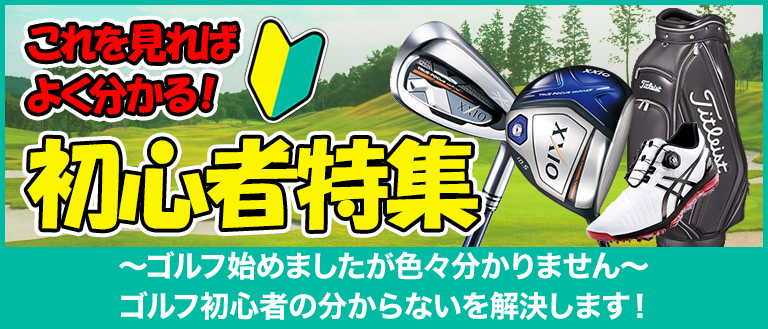
To all of you who are just starting out in golf, thank you for finding your way to the NIKI GOLF online page. This special feature is for those of you who have recently started playing golf, or who are thinking about taking up a little golf but have questions, concerns, or doubts and don't know who to ask... NIKI GOLF staff, who are here to support your enjoyable golf life, will explain things as clearly as possible and answer any questions you may have about golf.
Basic knowledge of golf
I don't even know what I don't know about golf...
For those of you who are just starting out in golf, we've put together a concise summary of essential basic knowledge and terminology you should know.
What kind of sport is golf?
This is a competition where the goal is to get the ball into the cup in the fewest strokes possible along a designated course.
When hitting the ball, you use a club. There are different types of clubs, each with different characteristics such as the distance they can hit, and players can freely choose the right club for each shot.
*On the green, only a putter is permitted.
*The maximum number of clubs you can bring to the course is 14.
What's so fun about golf?
・It's exhilarating to hit the ball as far as you can on the wide course!
When you sink a long putt, you can't help but pump your fist in the air!
- When a ball hit from near the green goes directly into the cup.
- It's fun to play on a course with friends you get along with.
Things don't always go well, but the occasional good hit feels really great.
Even on courses I frequent, there's a different level of difficulty and enjoyment each time, so I never get bored.
What is Driver? What is a wedge?
A glossary of basic golf equipment terms.
club
Tools for hitting a ball

Wood: A type of golf club. A general term for clubs with a round head shape. The term "wood" is a remnant of the time when they were made of wood, and even though they are now made of metal, they are still called woods.

Driver: A type of wood, also known as a 1-wood (W#1). It is the longest golf club and is designed to maximize distance.

Fairway woods: These come in 3-wood, 4-wood, 5-wood, 7-wood, etc. The lower the number, the longer the club and the greater the distance. The higher the number, the greater the distance, but the easier it is to get height.

Irons: A type of golf club. A general term for clubs with a triangular-shaped head. They are commonly used on the course as they are used to hit shots at different distances depending on the situation.

Irons: There are two types of irons: those that are expressed by numbers, such as 3-iron to 9-iron, and those that are expressed by the angle of the club, such as PW (pitching wedge), SW (sand wedge), "50°", "56°", etc.

Wedges: These are clubs used for shorter distances than a 9-iron, and are part of the iron family. They are very useful for adjusting distance and are therefore frequently used clubs.

Hybrid: A club that combines the characteristics of both woods and irons. Also known as a "utility club."

[Hybrid (Utility)]: A type of club whose length is similar to that of an iron, but whose head shape is similar to that of a wood.

Putter: The club used to roll the ball on the green and ultimately get it into the cup. It's the club you use most often.

Putter: Unlike other clubs, you cannot use any club other than a putter on the green at most golf courses. Therefore, a putter is an essential club.
The name of the club varies depending on its location and section.

Grip: The part of the club you hold. It's made of rubber or similar material to prevent slipping and make it easier to hold.
Shaft: The rod-shaped part of a club.
Head: The part of the club that has the hitting surface for striking the ball.
Bags and Cases
Here are some of my frequently used bags and cases.

Caddy bag: A bag specifically designed to hold golf equipment such as clubs. Lighter ones weigh between 2.5kg and 3.0kg, while larger ones can weigh 5.0kg or more.

Boston bag: A travel bag. It's convenient to have one, and some types can even fit shoes inside.

Shoe case: A bag for storing shoes.

Club case: A case that can carry about 4 to 6 clubs.

Ball case: A case that can hold 1 to 3 balls and can be attached to a belt or pants for easy carrying.
cover
Tools for protecting important clubs and other equipment.

Headcover: A cover used to protect a golf club from scratches.

Travel cover: A cover used when you want to ship your golf bag with your clubs inside.
shoes
The difference between these and sneakers lies in the soles!

Soft spike shoes: Golf shoes with removable spikes on the sole. In the past, metal spikes were used, but recently, soft materials such as rubber or plastic are used instead of metal, hence the name "soft spikes."

Spikeless shoes: Golf shoes that lack removable spikes and instead have a textured sole designed to prevent slipping.
Gloves
I recommend choosing something that fits your size perfectly.

Gloves: These are worn on the hands for protection and to prevent slipping when gripping a club.
tea
It would be a huge problem if you didn't have this when you actually went to the course.

Tee: A general term for a tool used for the first shot on each hole, which lifts the ball off the ground to make it easier to hit.

Long tees: Tees that are 7 cm or longer and used with clubs with large heads (mainly Driver).
Middle tee: A tee approximately 4-6 cm long used when hitting the first shot with a fairway wood, utility club, etc.
Short tees: These are tees, about 2-4 cm long, used when hitting the first shot with an iron or other club that you want to slightly elevate off the ground.
marker
This is something you'll definitely use on the green.

Marker: A coin-shaped object used on the green. It's an important item for smooth play by placing the marker in place of the ball only when it lands on the green, allowing you to pick up the ball.
Things to prepare when starting golf
A question I get asked a lot is, "What do I need to play golf?" Since it's difficult to prepare everything at once, I've divided the necessary items into categories such as "I want to practice my swing and go to the driving range," "I want to go to a short course," and "I want to go to an 18-hole course."
I want to practice my swing and go to the practice range.
- Clubs (1 or 2 are OK)
- *It would be better to have it if possible.
- Gloves
- Shoes
It's reassuring to have an experienced person to practice with, but if you're going to a driving range with a friend for the first time, check the range's website or ask the receptionist, "This is my first time practicing, could you please explain the system at the driving range?"
You can simply practice hitting the ball, or you can observe what other people are doing. Trying to imitate skilled players might lead to some wonderful discoveries.
club
Buy an iron that's sold individually, or get one from a friend or acquaintance – just get one club.
If the driving range has rental clubs, you can go empty-handed for your first practice session.
*Try asking your local driving range if they have rental clubs available.
Gloves and shoes
Gloves are a good item to have for protecting your hands and preventing slippage while practicing.
Also, since practicing in sneakers or leather shoes can cause them to tear or get damaged, it's better to have golf-specific shoes if possible.
I want to go to a short course.
- Clubs (a few irons, putter is essential)
- ball
- Shoes
- tea
- marker
- Gloves
- *It would be better to have it if possible.
- Golf bag/club case
There's no better practice than actual play. If you agree with that, then we recommend a "short course." It's called a short course because the overall distance is considerably shorter than a real golf course.
While it won't help you hit the ball very far, it's recommended for improving your short-distance iron shots to improve your golf score, and for improving your putting skills on the green.
club
The essential clubs you'll need are a few irons for hitting different distances and a putter.
ball
A ball is also absolutely necessary to get onto the course.
Sometimes the ball can fly off in an unexpected direction and get lost, so it's a good idea to have enough balls on hand so that you can afford to lose at least one per hole.
Shoes
Unlike the driving range, the course has unstable footing, slopes, and slippery grass, so you should play in golf shoes.
tea
For the first shot on each hole, you can use a tee to lift the ball slightly off the ground before hitting it.
While there's no rule against hitting from the ground, it's a good idea to use the tools available to make hitting easier, so prepare them.
marker
On the green, where there is a cup to put the ball, it is permissible to pick up the ball by placing a coin-shaped marker in place of the ball.
*Moving or touching the ball anywhere other than on the green is generally a rule violation and will result in a penalty being added to your score.
The main reason for picking up your ball on the green and using a marker is that other players' balls can get in the way as you try to put your ball into the cup. Without a marker, you won't be able to react to this and it will hinder your play, so be sure to have one ready.
Club case
This is a portable storage bag that can hold approximately 4 to 6 clubs.
On short courses, the number of clubs you can use is limited, and you're usually limited to about six clubs. So, if you're only taking a few clubs to a short course or the driving range, this is a handy item to have.
I want to go to a course with 18 holes.
- Various clubs (putter required)
- Caddy bag
- ball
- Shoes
- tea
- marker
- Wear
- Gloves
Various clubs
On the course, you'll be aiming for the cup under various distances and conditions.
Prepare clubs for long drives, clubs for short shots, and clubs for hitting the ball high. Since you'll be using a putter on the green, be sure not to forget your putter.
Golf bag
A golf bag is designed to hold clubs, but it can also store balls, markers, tees, and other items. Many courses require a golf bag for playing, so be sure to bring one.
Shoes
You may need to search for and hit the ball on quite steep slopes, so be sure to wear golf-specific shoes.
Ball tee marker
These are essential items for playing the game. Don't forget to prepare them.
Wear
While comfortable clothing is generally acceptable on a golf course as it's a sport, golf also has a social aspect, and some courses have dress codes (rules regarding clothing).
Please avoid wearing jeans and sandals when visiting the golf course. A safe choice of attire would be a collared shirt, such as a polo shirt, paired with trousers.
There are no strict rules regarding attire, and the rules vary depending on the course. Therefore, we recommend checking the website of the course you plan to take, or contacting them in advance by phone or email.
Various golf trivia
Regarding the percentage of golf clubs used
I investigated how many times amateur golfers use each club when playing an 18-hole course.
I also asked about the approximate distance to which that club should be used.
We asked several male golfers who average 100-120 strokes per round, and here are the results.
Number of times the club was used
Driver: 12-14 times
Fairway woods and utilities: 8-16 times
Irons and wedges: 40-56 times
*Number of wedges used for short distances among irons: 30-40 shots
Putting: 34-44 times
The approximate distance that each club can hit
Driver distance: 190 yards to 250 yards
Distances hit with fairway woods: 170 yards to 220 yards
Distances hit with a utility club: 160 to 200 yards
Distances hit with irons: 90 yards to 180 yards
Distance hit with a wedge: Less than 100 yards
Putting: All on the green
Looking at it this way, clubs used for short distances of 100 yards or less on the green account for 60-70% of the total, so it seems like a good idea to gain experience on a "short course" which only has this element.
Dress code etiquette on the golf course
The basics of "appropriate attire for golf" are "collared shirts" and "pants, shorts, or skirts." On the course, shoes are even more important.
Golf shoes must be specifically designed for golf. Spikeless or soft-spiked golf shoes are acceptable (sneakers and sandals are not permitted).
*Unlike a practice range, swinging on slopes or grass with regular shoes that don't have anti-slip features is extremely dangerous.
Collection of clothing bloopers

Tops that are a no-no
Collarless shirts, T-shirts, V-necks, tank tops
Bottoms that are a no-no
Denim fabric or extremely revealing clothing: denim pants, denim skirts, extremely short skirts, shorts.
Other NGs
Sandals and flashy clothing, for example.
For men
T-shirts, jeans, and sandals are not allowed.
A collared shirt and suitable long pants are preferable.
In the case of women
Tank tops, denim hot pants, and sandals are not allowed.
Shirts with collars and skirts (with built-in undergarments) are preferred.
How to choose tools
I don't know what golf equipment I need or how to choose it... Let's make a pleasant shopping experience by keeping the important points in mind.
club
The minimum necessary clubs are a "long-distance club," a "short-distance club," and a "putter." A putter is especially essential. You should have 2-3 clubs for each category: "long-distance club" and "short-distance club."
1. Clubs that generate distance
(Wood utility clubs, 5-iron, 6-iron, 7-iron)
2. Clubs for short distances
(Irons: 8-iron, 9-iron, pitching wedge, approach wedge, sand wedge)
PW (Pitching Wedge): A common term for a club with a loft angle of approximately 45°.
AW (Approach Wedge): A common term for a club with a loft angle of around 50°.
SW (Sand Wedge): A common term for a club with a loft angle of around 56°.
3. Putter (essential)
bag
You can pack a change of clothes, shoes, rain gear, etc.
A size of at least 50cm wide x 30cm deep x 30cm high would be convenient.
Shoes
On a golf course, you walk on steep slopes and brace yourself to swing the club.
If your shoes are too loose and your feet move around inside them, it can lead to sprains and other unexpected injuries, so choose a size that fits snugly.
Gloves
Even if a glove feels like a perfect fit with your hand open, it may loosen when you bend your fingers. Choose a size that provides minimal looseness in your fingertips and palm when you grip the handle.
ball
If the ball is lost, the game cannot be played.
Also, having fewer balls left creates unpleasant pressure. It's a good idea to have plenty on hand at the beginning.
*I took two dozen (24) golf balls with me on my first golf game, but I lost 19 of them...
tea
The length of the tee you use depends on the club you'll be using to hit the ball first on the hole. Larger clubheads require longer tees, while irons require shorter ones.
Prepare a long club for Driver and a shorter club for the irons.
Examples of tee lengths to use for different clubs
Driver: Length of 7cm or more (long enough to lift the ball about 4cm to 5cm when stuck in the ground)
Woods/Utilities: Approximately 4cm to 6cm in length (long enough to lift the ball about 1cm to 3cm when stuck in the ground)
Irons: Approximately 2cm to 4cm in length (long enough to lift the ball about 0.5cm to 2cm when stuck into the ground)
marker
Actually, almost anything coin-shaped will do!
The current trend is for markers to attach to a magnetic clip. These clips can be attached to hats or belts, eliminating the need to search through pockets and supporting smoother play.
summary
How do you like it?
Have you learned a little about golf and the necessary equipment?
NIKI GOLF supports your golf life and enjoyable shopping. If you have any questions, especially when shopping online, please feel free to contact NIKI GOLF online support desk.